Yes, cataract surgery can now be performed using advanced laser technology.
To view the 2025 Surgery Outcome Report Click Here
This bladeless, computer-guided approach allows for a highly precise and customized procedure, enhancing both accuracy and safety.
Drs. Alan Solinsky, David Jeng, Jeremy Hwang, and Brian Solinsky all perform laser-assisted cataract surgery. They use the state-of-the-art LenSx® laser system, located at the Hartford Hospital Eye Surgery Center in Newington, Connecticut.
As this technology continues to advance, it is expected that within the next 5 to 10 years, most—if not all—cataract surgeries will be performed using laser assistance.


Leading eye surgeons widely view bladeless laser cataract surgery as the future of cataract treatment.
The FDA-approved LenSx® laser system uses the same advanced femtosecond technology found in bladeless LASIK procedures. This technology gives surgeons exceptional, image-guided control, allowing each procedure to be carefully planned and customized to the unique characteristics of a patient’s eye. The added precision and accuracy can lead to improved visual outcomes and may increase the chance of reducing dependence on glasses after surgery.
Instead of a traditional handheld blade, the laser is used to create precise, consistent incisions, enhancing both accuracy and reproducibility. The LenSx® platform also incorporates optical coherence tomography (OCT), which captures detailed, high-resolution images of the eye. Using this data, the system’s software helps the surgeon design a personalized treatment plan and then guides the procedure in real time. A specialized patient interface keeps the eye stable and connected to the system, allowing the surgeon to maintain precise control throughout the surgery.
While traditional cataract surgery remains a safe and effective option, bladeless femtosecond laser-assisted surgery offers important advantages for many patients:
- Precision – The computer-guided laser maps the eye in detail and performs highly accurate micro-incisions. It can also correct astigmatism and create a perfectly circular opening in the lens, which helps optimize visual results.
- Safety – Laser-created incisions are highly controlled and consistent. Additionally, the cataract is softened before removal, reducing the amount of ultrasound energy needed during the procedure.
During your consultation, your doctor will discuss whether femtosecond laser-assisted cataract surgery is right for you and help guide your decision.
Solinsky EyeCare is proud to offer advanced technologies that enhance both the precision and outcomes of cataract surgery.
LAL – Light Adjustable Lens
Your vision. Your way!
The Light Adjustable Lens™ (LAL®) is the first and only lens that can be customized after cataract surgery—because we believe your vision should be exactly what you want. Now you can experience your vision, then refine it. So your vision will truly be yours.
Fixed vs. Adjustable Lenses
With other lenses, you have to make a lot of decisions about the vision you want before your cataract surgery. Once implanted, those lenses can’t be changed; they’re what’s known as “fixed.”
The Light Adjustable Lens, however, is an adjustable lens. This means that the only decision you have to make before your surgery is to choose the Light Adjustable Lens. The rest can be made after your surgery once your eye has healed. You and your surgeon then have the ability to adjust the lens and optimize your vision based on your unique preferences and lifestyle requirements. So you will truly have vision that’s just for you.
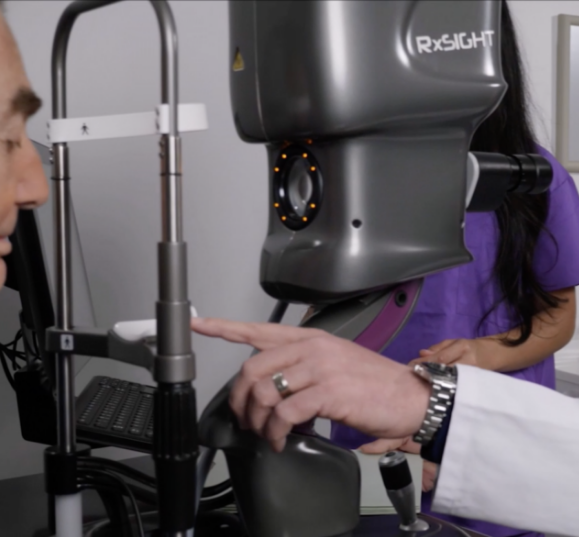
The Light Adjustable Lens is made of a special photosensitive material that changes the shape and power of your implanted lens in response to ultraviolet (UV) light to optimize your vision. The Light Delivery Device™ (LDD™) non-invasively delivers this UV light to precisely reshape your lens based on the visual correction that is needed to target your custom prescription.
Light Treatment Schedule
UV light treatments will be performed in your doctor’s office after your eye has healed. Depending on your desired visual outcome, you may have 1–3 light treatments, followed by two “lock-in” treatments to prevent further changes.
After surgery, and while your vision is still in the adjustment phase, you will be required to wear RxSight UV-protective glasses that prevent UV light from altering your lens to protect it before the final lock-in.
The VERION™ Image Guided System helps reduce potential sources of error at every stage of the procedure, improving efficiency and accuracy to support the best possible visual results.
Learn more about this innovative new technology»
We also utilize VerifEye technology, further advancing our ability to deliver precise, customized care.
In addition, the Optiwave Refractive Analysis (ORA) System provides real-time measurements during surgery, helping us refine results and often achieve vision outcomes comparable to those seen with LASIK procedures.